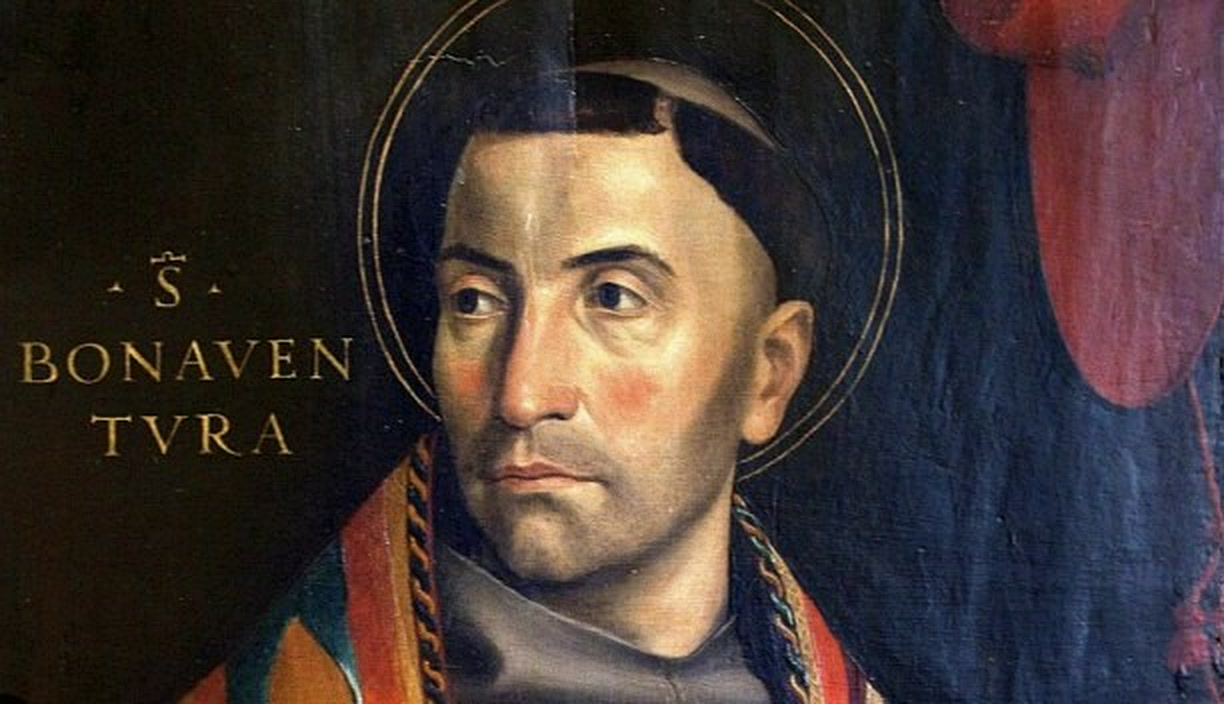
Birth and childhood
Saint Bonaventure was born between 1217 and 1221 in the small town of Bagnoregio, near Viterbo in central Italy. His baptismal name was John, son of John of Fidanza and Maria of Ritello. Tradition tells that as a small child he fell gravely ill, and his mother prayed for him through the intercession of Saint Francis of Assisi, after which he recovered. Bonaventure himself later wrote that he had been saved from death through the intercession of St Francis, and that event stayed in his heart all his life.
Studies and religious vocation
As a young man he went to study at the University of Paris, then the chief centre of learning in Europe. About the year 1243 he joined the Order of Friars Minor (Franciscans) and received the name Bonaventure. He studied theology under the renowned master Alexander of Hales, and later became a master himself. In that period he worked alongside Saint Thomas Aquinas, a Dominican; both received the licence to teach theology in 1257, and they remained friends who loved and respected one another.
Minister General of the Franciscans
In 1257, at about the age of 36, Bonaventure was elected Minister General of the whole Franciscan Order. At that time the Order was divided over how to live the poverty that St Francis had lived. With wisdom, gentleness and firmness he led it for 17 years, bringing unity and laying down rules that helped the Order to grow in peace. For that reason he is often called the “second founder” of the Franciscans. He also wrote the official life of St Francis (Legenda Maior), approved by the Order in 1263.
Writings and teaching
Bonaventure was a theologian and a teacher of prayer. He joined learning to love: for him, to know God had one purpose — to love him more. His famous book, The Journey of the Mind into God (Itinerarium mentis in Deum), explains how a person can rise step by step from creatures to the Creator, through Christ crucified. He also wrote the Breviloquium, a summary of the Christian faith, and many meditations on the passion of Christ. Because of his great love for God he is called the “Seraphic Doctor”, likened to the Seraphim, the angels who burn with love before God.
Cardinal and the Council of Lyon
His humility was widely known. In 1265 Pope Clement IV appointed him Archbishop of York in England, but he begged not to be given that office. In 1273 Pope Gregory X made him Cardinal and Bishop of Albano. Tradition says that when the envoys brought him the cardinal's hat they found him washing dishes, and he asked them to hang it on a tree until he had finished his work. The Pope gave him the task of helping to prepare the Second Council of Lyon (1274), aimed above all at restoring unity between the Church of the West and the Greek Church of the East.
Death and canonisation
Bonaventure died on 15 July 1274 in Lyon, France, while the Council was still in session, and he was buried there. Pope Sixtus IV declared him a Saint on 14 April 1482, and in 1588 Pope Sixtus V declared him a Doctor of the Church. The Church keeps his memorial every year on 15 July.
What we learn from him
The life of St Bonaventure teaches us that learning and holiness can go together; that true leadership is humble service; and that the purpose of all we learn is to love God and our neighbour more. He left us the example of a man who was a great scholar, yet remained a lowly servant of Christ.